


Does Window Film Make a Room Dark? A Straight Answer From a Specialist
Window film does not automatically make a room dark. The outcome depends entirely on the visible light transmission, known as VLT, of the film chosen. A frosted
11 October 2026
Share this article



Last updated: October 10, 2026
Quick Answer
Window film does not automatically make a room dark. The outcome depends entirely on the visible light transmission, known as VLT, of the film chosen. A frosted privacy film can let most daylight through a window while a blackout film can reduce a room to near darkness, so the right choice depends on the room, the glass and what the household actually wants from it.
Key Takeaways
- Most window film does not make a room dark. The result depends on the VLT rating of the specific film, not on window film as a category.
- Blackout and heavily reflective films can bring a room close to full darkness, while frosted and decorative privacy films can keep a room genuinely bright.
- Privacy window film with a high VLT figure lets most daylight through a window while still softening the view from outside.
- Solar control window film that helps reduce heat often reduces some light too, though usually in a modest way rather than a dramatic one.
- Daylight-redirecting film is designed to brighten the back of a room rather than darken the front of it.
- Professionally installed window film keeps its privacy and light-control properties for many years, though poor-quality film can discolour over time.
- North-facing rooms generally suit a lighter shade of film because they receive less natural brightness to begin with.
- Comparing film by VLT percentage, rather than by the word "tinted," is the most reliable way to predict how a room will feel.
Choosing professionally installed window film for the right reason, rather than assuming any tint will do the job, is what separates a comfortable room from a disappointing one. Below, each common question about window film and room darkness is answered in turn.
Does window film make rooms darker?
Window film can make a room darker, though it does not have to. The change in brightness depends on the film's VLT rating, the room's orientation and the amount of natural light the window already receives.
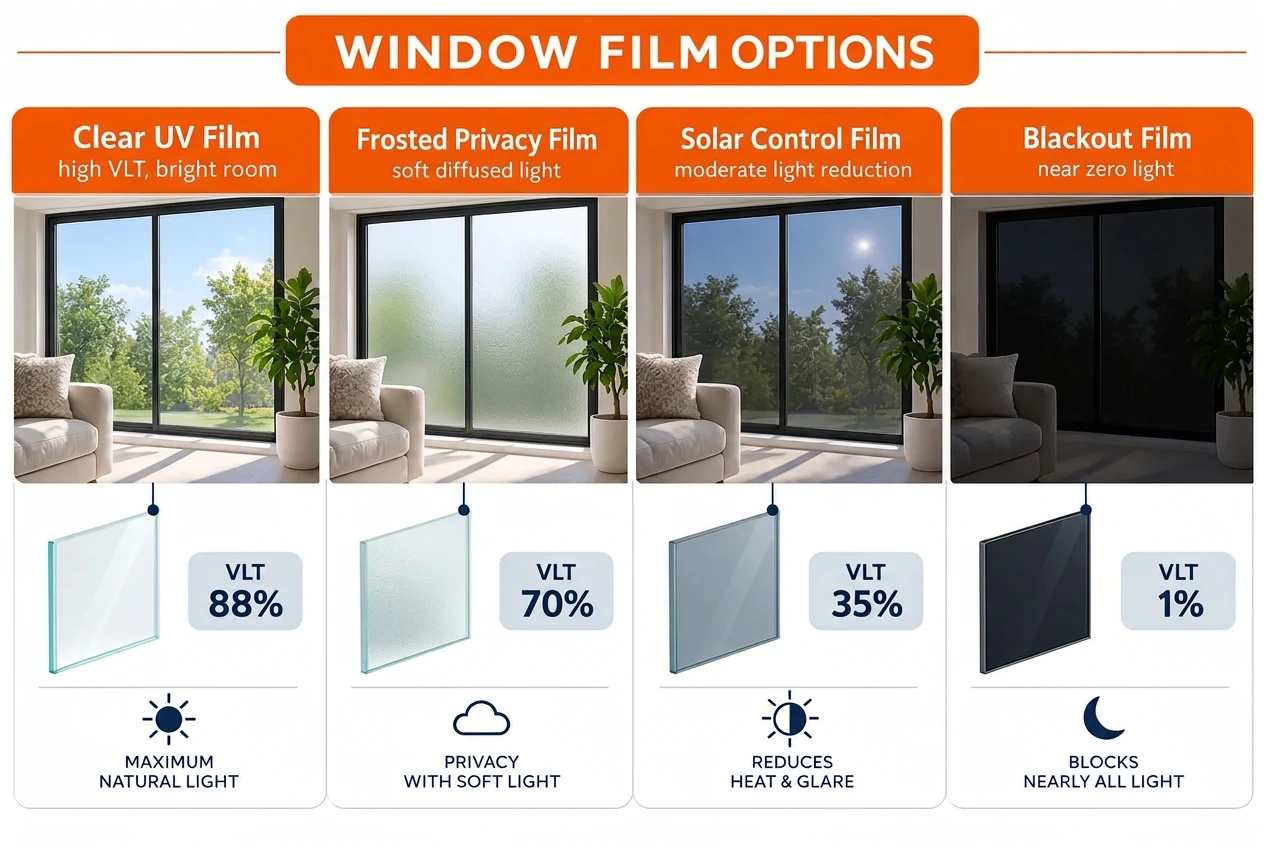
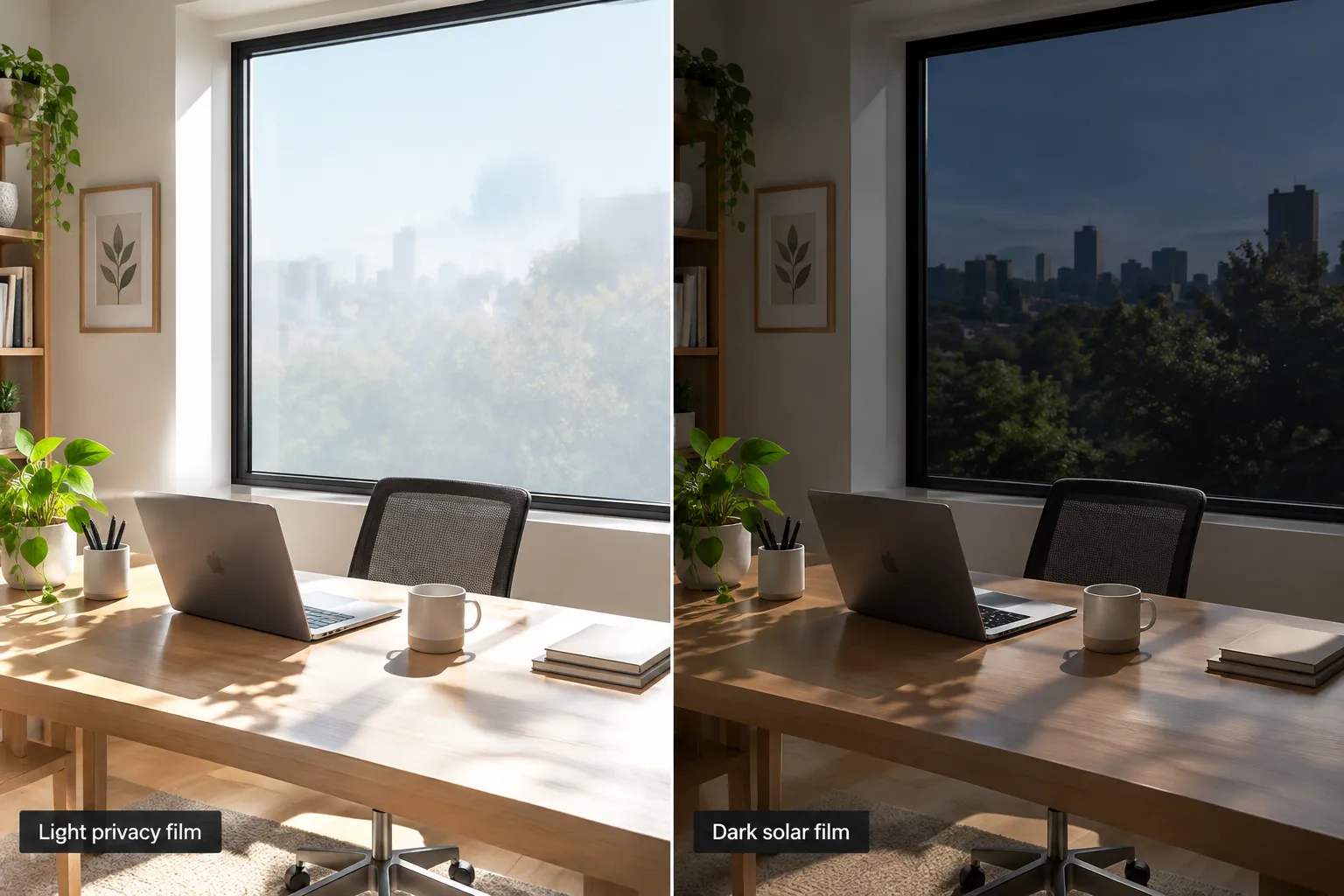
A film with a VLT of 70 percent or higher will usually be barely noticeable in terms of daylight loss. A film sitting below 20 percent VLT, such as many blackout products, will visibly dim a room on even a bright day [2]. This is why two homeowners can fit "window film" and report completely different experiences. One chose a decorative design for softness and privacy. The other chose a heavy solar film for a south-facing room that got uncomfortably warm. Both are correct descriptions of window film, just at opposite ends of the same scale.
A good decision rule: choose film based on how the room is used, not on the assumption that all tint behaves the same way.
How much light does window film actually block?
The amount of light a film blocks is described by its VLT percentage, which measures how much visible light passes through the glass after the film is applied. A VLT of 50 percent means roughly half the daylight that would normally enter the room still gets through.
Manufacturers typically group film into a small number of bands:
Film type Typical VLT range effect on room clear UV protective film80 to 90 percent barely noticeable change light privacy or decorative film50 to 80 percent softer light, full view-control Solar control tinted film20 to 50 percent noticeably calmer light, cooler feel reflective or one-way film5 to 20 percent clearly darker during the day Blackout film Under 5 percent Near-total darkness [8]
The same glass can carry completely different experiences depending on where it sits on that table. A homeowner who wants a brighter room but still wants privacy should look for film in the higher bands, not assume privacy only comes from a darker option.
Which window film gives privacy without darkening a room?
Decorative window film and frosted film designs are generally the best choice for privacy without losing daylight. These films scatter light rather than blocking it, so a room can stay bright while the view through the glass becomes obscured [7].
Common high-VLT privacy options include:
- Frosted or etched-look film, which gives an even, softened glass appearance.
- Decorative patterned film, including dot, stripe or textured designs, often sitting above 60 percent VLT.
- Semi-privacy film with partial patterning, which obscures shapes while still allowing good daylight through.
A useful decision rule: if the goal is softer light and a private feel rather than a dark room, choose a decorative or frosted design over a dark solar tint. TwilightTint fits privacy window film across homes in Chichester, Worthing and Petersfield for exactly this reason, often for bathrooms, ground floor rooms and street-facing lounges.
How do window film darkness levels compare by percentage?
Window film darkness is best compared using the VLT percentage scale rather than general terms like "light" or "dark." A 70 percent VLT film and a 15 percent VLT film can look completely different in the same room, even though both are described as window film.
As a rough guide, each drop of roughly 20 percentage points in VLT produces a clearly noticeable change in how bright a room feels, especially on an overcast day when there is less daylight to begin with. Film manufacturers test VLT under laboratory conditions and industry guidance consistently points buyers toward choosing film by VLT rather than by appearance alone [10]. This is the single most reliable way to compare two window film products before fitting.
Can you see through window film from outside at night?
Reflective and one-way window film loses most of its daytime privacy once it gets dark outside, because the effect relies on brighter light outside than inside. At night, with interior lights on, the glass can become see-through from the outside [10].
Frosted and decorative film, by contrast, keeps working after dark because the privacy comes from scattering light rather than from a reflective coating. For rooms that need privacy around the clock, such as bathrooms or ground floor bedrooms, frosted or patterned film is usually the more dependable choice. A simple edge case worth knowing: even the best privacy film performs better at night if curtains or blinds are added behind it, since no single layer removes every angle of view completely.
Window film vs curtains for light control
Window film and curtains solve light and privacy differently and many households benefit from using both. Window film provides a constant, even level of privacy and glare control throughout the day. Curtains offer an adjustable layer that can be opened fully or closed completely whenever needed.
Window film cannot be switched off during the day, which is why the VLT choice matters so much at the point of fitting. Curtains, meanwhile, do nothing during daylight hours unless they are drawn, which many households are reluctant to do while the sun is out. Reviewing the practical differences in detail in this comparison of window film and blinds is worthwhile before deciding between the two and many comfortable homes simply use both together.
Does window film reduce heat and light equally?
Window film does not reduce heat and light by the same amount. Solar control film is engineered to reduce solar heat gain more aggressively than it reduces visible light, so two films with similar VLT ratings can still feel very different in terms of warmth [9].
This matters for conservatories and south-facing rooms across West Sussex and Hampshire, where the goal is usually a calmer, cooler conservatory rather than a darker one. A well-chosen solar control film helps reduce heat and helps reduce glare while keeping the room usable, rather than simply dimming the glass. The decision rule here is straightforward: ask what percentage of heat a film manages separately from its VLT figure, rather than assuming the two numbers move together.
Which window film blocks UV but keeps a room bright?
Clear and near-clear UV protective film is the best option for blocking UV rays while keeping a room fully bright. These films typically sit above 80 percent VLT, so daylight is barely affected while furniture, flooring and fabrics still gain protection from fading [9].
This is a common misconception worth correcting: UV protection and darkness are not the same property. A completely clear window film can block the vast majority of UV light without changing how bright a room looks, because UV sits outside the visible light spectrum that VLT measures. Homeowners worried about sun-faded sofas or flooring, but who do not want a darker lounge, should ask specifically about UV-rated clear film rather than assuming a tinted option is required.
How to install window film without making a room too dark
The safest way to avoid an overly dark result is to check the VLT rating before fitting, not after. Asking for the exact percentage, rather than relying on a swatch viewed under shop lighting, avoids most disappointment.
A simple pre-installation checklist:
- Identify the room's main purpose, whether that is privacy, glare reduction or UV protection.
- Note the window's orientation, since north-facing glass needs a lighter window film than a south-facing one.
- Ask for the VLT percentage of the shortlisted film, not just its description.
- Request a small sample viewed in the actual room, at the actual time of day it matters most.
- Confirm the price and installation timeline before booking, since meticulous preparation takes longer than a rushed fit.
A common mistake is choosing window film purely by look in a showroom, then discovering the room feels gloomier once fitted across every window rather than a single sample pane. TwilightTint's professionally installed window film service across West Sussex and Hampshire always starts with this kind of conversation before any glass is touched.
Which window film works best for bathrooms that need privacy?
Frosted film is generally the best window film for bathrooms, because it provides full privacy without needing a dark, moody finish. Etched and patterned designs are also strong options for this room specifically [7].
Bathrooms often have small windows and limited natural light already, so a dark solar window film is rarely the right class of product for the space. A softer, high-VLT decorative film keeps the room feeling open while still stopping anyone outside from seeing in. This is one of the clearest examples of where privacy and brightness are not opposites, provided the right design is chosen for the glass. Details like glass texture and frame colour also affect the final result, so a quick chat about the room's specific details before fitting avoids surprises.
Does window film darken over time?
Good quality window film does not darken meaningfully over time when professionally installed and properly maintained. Cheap or poorly fitted window film, however, can discolour, bubble or develop a hazy appearance after a few years of sun exposure.
This is one reason specialist focus matters more than a quick DIY fit. Meticulous preparation, correct trimming and a clean application all affect how a film ages on the glass, not just its original VLT rating. A film that starts at 70 percent VLT should still look close to that figure years later if it was installed correctly and from a reputable product range. TwilightTint's over 20 years of experience can help you choose the right window film.
References
- 3m Daylight Redirecting Film
- Verduisterende Raamfolie
- 3m Tm Daylight Redirecting Film Retail Case Study
- Daylight Redirecting Film
- Full Story
- 3m Daylight Redirecting Film Hamilton Aitken Architects Case Study
- Frosted Window Films Djgkq
- Blackout Window Film
- Low Energy Facades Daylighting
- Privacy Glass Film Complete Guide To Window Privacy Solutions
- Privacy Film For Windows Enjoy Comfort Privacy And Style
- Sun Protection Films Jpozm
- Building%20envelope%20daylighting
- One Sided Glass
- Residential Window Film For Privacy And Comfort
Table of content
- Quick Answer
- Key Takeaways
- Does window film make rooms darker?
- How much light does window film actually block?
- Which window film gives privacy without darkening a room?
- How do window film darkness levels compare by percentage?
- Can you see through window film from outside at night?
- Window film vs curtains for light control
- Does window film reduce heat and light equally?
- Which window film blocks UV but keeps a room bright?
- How to install window film without making a room too dark
- Which window film works best for bathrooms that need privacy?
- Does window film darken over time?
- References


Join us on our journey as we transform your glazing and help you achieve its full potential.
Feel free to get in touch with us via our chat widget
@ TwilightTint Ltd 2026. All right reserved.
X


Youtube
